
Gold Coast vs Sunshine Coast: What It's Actually Like to Live in a Tourist Town
From the photos, both coasts look like the obvious place to live in Australia — clear water, white sand, year-round warmth, and a pace of life that makes Melbourne winters seem absurd. The reality of actually living in a tourist destination is more nuanced than the Instagram version. The job market is real but specific. The social scene has a particular transient quality. The cost of living is genuinely lower than Sydney, with some categories that will surprise you in the other direction. This guide covers both coasts honestly — including who each one actually suits, and who will be quietly disappointed after six months.
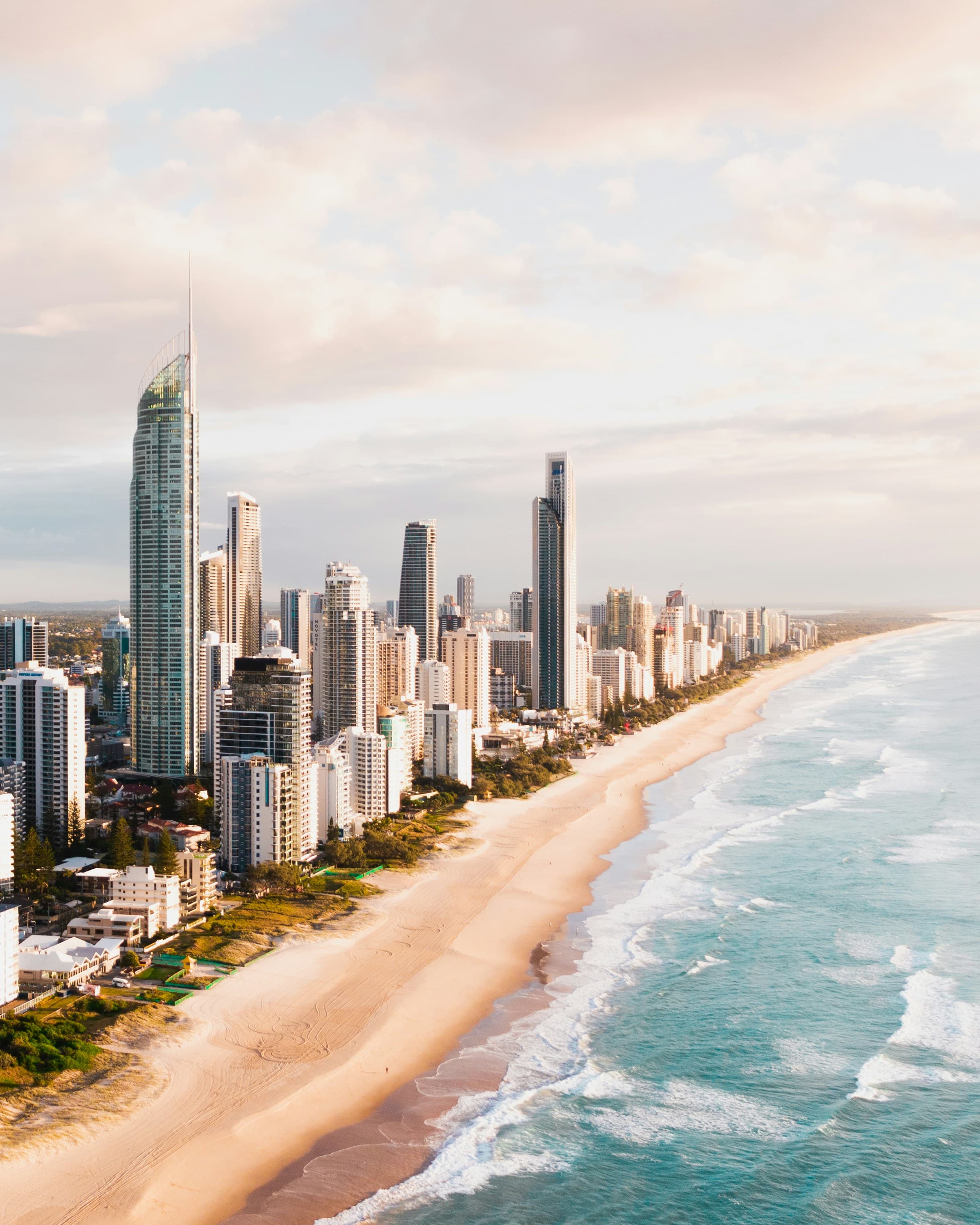
The Gold Coast and Sunshine Coast sit on either side of Brisbane — the Gold Coast about 80 kilometres to the south, the Sunshine Coast about 100 kilometres to the north. They're close enough to Brisbane to be considered part of the same regional ecosystem, and different enough from each other that choosing between them matters more than most people realise before they arrive.
The Gold Coast is bigger, louder, and more economically developed — a city of 750,000 people with a proper CBD, a light rail network, a university hospital precinct, and a skyline of high-rise towers that makes it look, from certain angles, like a smaller Miami. The Sunshine Coast is quieter, more spread out, more self-consciously community-oriented — a string of towns rather than a unified city, with a growing technology and health sector that has attracted a specific kind of professional migrant who wants the lifestyle without the nightclub strip.
Both have exceptional beaches. Both have year-round warmth. Both are genuinely liveable. They suit different people.
The Key Numbers Side by Side
Rent: The Number That Separates Them
The rent gap between the two coasts is larger than most people expect. Sunshine Coast rents run approximately 35% below Gold Coast for equivalent properties — a difference driven by the Gold Coast's higher population density, greater tourism demand, and more developed infrastructure pulling rental prices up.
| Property Type | Gold Coast (pw) | Sunshine Coast (pw) | Sydney (pw) |
|---|---|---|---|
| Share house room | $250–$380 | $200–$300 | $380–$450 |
| 1-bed apartment | $480–$620 | $380–$520 | $600–$780 |
| 2-bed apartment | $580–$760 | $460–$620 | $800–$1,000 |
| Beachfront 2-bed | $750–$1,100+ | $580–$850 | N/A equivalent |
The beachfront premium is real on both coasts — proximity to the water adds $150–$300 per week to rental costs at Surfers Paradise, Broadbeach, Noosa, and Mooloolaba. Heading inland — Southport and Robina on the Gold Coast, Maroochydore CBD and Sippy Downs on the Sunshine Coast — reduces rents significantly while keeping reasonable access to the coast.
⚠️ Both coasts have tight rental markets — and seasonal peaks that make it worse Queensland's southeast corner has experienced sustained population growth since 2020, and rental vacancy rates on both coasts remain below 1.5%. The situation tightens further during December–February (summer holidays and university intake) when short-term holiday rentals compete with long-term rentals for the same properties. If you're arriving in December or January, start searching on realestate.com.au and Domain at least three to four weeks before arrival, have all your documentation ready, and budget for the possibility of short-term accommodation while you secure a permanent place.
The Job Market: Where Each Coast Wins
Both coasts have job markets built around tourism, hospitality, retail, and construction — with meaningful additional sectors that distinguish them from each other.
Gold Coast: Tourism, Health, and the Olympics Pipeline
The Gold Coast's economy is the larger and more diversified of the two. Tourism and hospitality remain the dominant employers — the city receives approximately 12 million visitors per year, generating consistent demand for hospitality, retail, events, and accommodation workers year-round. Beyond tourism, the Gold Coast University Hospital and health precinct in Southport is one of Queensland's largest employers, the education sector (Griffith University, Bond University, TAFE) creates consistent demand, and the city's infrastructure build ahead of the 2032 Brisbane Olympics has construction and trades work running at a sustained pace.
The Gold Coast's tourism economy means hospitality work is genuinely accessible — more so than in Adelaide or Canberra, and comparable to Melbourne's inner-city hospitality density. The trade-off is that hospitality work on the Gold Coast has a distinctly seasonal quality, with December through February and the school holiday periods producing noticeably more work than the quieter winter months.
Sunshine Coast: Healthcare, Tech, and the Quieter Growth Story
The Sunshine Coast's economic story is less obvious than the Gold Coast's but increasingly interesting. The Sunshine Coast University Hospital — opened in 2017 — has become a major regional employer and created a healthcare cluster that continues to grow. The Sunshine Coast has also attracted a meaningful cohort of technology and innovation businesses, drawn by the combination of lower costs than Brisbane, strong digital infrastructure, and a lifestyle that attracts skilled workers who have realised they can work remotely.
Sippy Downs, Maroochydore, and the Sunshine Coast Airport precinct have all seen investment in business parks and commercial development that didn't exist a decade ago. For tech workers, healthcare professionals, and small business operators, the Sunshine Coast's job market is broader than it appears from the outside — and the competition for roles is lower than in Brisbane or the Gold Coast.
| Field | Gold Coast | Sunshine Coast |
|---|---|---|
| Hospitality / Tourism | Excellent — year-round demand | Good — smaller scale, more seasonal |
| Healthcare / Nursing | Strong — large university hospital | Strong — growing hospital precinct |
| Construction / Trades | Very strong — Olympics pipeline | Good — sustained population growth |
| Tech / Remote Work | Moderate — growing coworking scene | Good — intentional tech attraction strategy |
| Education | Good — Griffith, Bond, TAFE | Moderate — USC, TAFE |
| Finance / Corporate | Limited — mainly Brisbane-based | Limited |
💡 The 88-day regional work requirement — both coasts have options nearby Working holiday makers completing the 88-day specified regional work requirement for a second-year visa have options accessible from both coasts. The Scenic Rim, Lockyer Valley, and Darling Downs — all within 1–2 hours of the Gold Coast — have agricultural and horticultural work that qualifies. The Sunshine Coast Hinterland, Gympie region, and Wide Bay area to the north offer similar options. Neither coast is a regional work destination itself (both are excluded from the postcode lists), but both make a reasonable base for people doing day trips or short stints to nearby qualifying areas.
Transport: The Car Dependency Problem
Both coasts are car-dependent — more so than Brisbane, and significantly more so than Sydney or Melbourne. This is the most consistent frustration reported by people who move to either coast expecting the kind of public transport access they had in a larger city.
The Gold Coast has the better public transport of the two. The G:link light rail runs from Broadbeach in the south through Surfers Paradise, Southport, and the hospital precinct to Helensvale in the north, where it connects to the Brisbane train network. For people who live and work along this corridor — which covers the densest and most employment-rich parts of the city — car-free living is genuinely possible. Outside this corridor, the bus network is functional but slow, and many parts of the Gold Coast's outer suburbs are effectively inaccessible without a car.
The Sunshine Coast has no light rail and limited train access — the Sunshine Coast train line runs from Nambour to Brisbane but doesn't penetrate the coastal areas where most people live and work. The bus network covers the main routes but with limited frequency. For most Sunshine Coast residents, a car is not optional — it is a basic requirement of daily life. Budget for car ownership (registration, insurance, fuel — approximately $400–$600 per month total) as a fixed cost before calculating your Sunshine Coast budget.
Climate: Genuinely Queensland
Both coasts share Queensland's subtropical climate — warm to hot year-round, with a wet season from November to March that brings humidity, afternoon thunderstorms, and occasional severe weather. The differences between them are modest but worth noting.
The Gold Coast averages 250+ sunny days per year, with an average temperature of 25°C and mild winters where beach days remain possible even in July. The Sunshine Coast is marginally cooler and receives slightly more rainfall — the hinterland geography catches weather systems that move up the coast — but the difference is small in practical terms.
Both coasts have genuinely spectacular spring and autumn seasons (April–May and September–October) where the humidity drops, the temperature sits at 22–26°C, and the beaches are at their most accessible. These are the months that make people understand why Queensland keeps growing at the rate it does.
The honest caveat: Queensland summers are hot and humid in a way that requires acclimatisation. January in Surfers Paradise at 31°C with 80% humidity and an afternoon storm that delays every outdoor plan is a different experience from the brochure photos. Air conditioning is essential. Budget for it.
The Social Reality: Living Among Tourists
This is the aspect of both coasts that surprises people who haven't lived in a major tourist destination before. Both the Gold Coast and Sunshine Coast have permanent resident communities — real neighbourhoods, schools, local businesses, and social networks that have nothing to do with tourism. But they also have a constant flow of visitors, working holiday makers, and short-term residents that gives the social environment a different texture from a city like Adelaide or Canberra.
On the Gold Coast, the Surfers Paradise and Broadbeach strips have a nightlife and entertainment scene that exists primarily for tourists and visiting Australians rather than for permanent residents. Long-term Gold Coast residents typically don't spend much time on the tourist strip — they have their own social geography in suburbs like Burleigh Heads, Currumbin, and Mermaid Beach that sits alongside but separate from the visitor economy. For working holiday makers, the tourist strip creates a ready-made social scene that makes meeting people easy; for people seeking a more settled community feel, the inner suburbs away from the strip provide it.
The Sunshine Coast has a different social energy — more settled, more community-oriented, less transient. Towns like Noosa, Buderim, Maleny, and Montville have strong local identities and established communities. Mooloolaba and Caloundra have a mix of permanent residents and visitors but feel less tourist-dominated than Surfers Paradise. For people who want a quieter community feel with beach access, the Sunshine Coast delivers this more naturally than the Gold Coast.
I moved to Burleigh Heads expecting to spend every weekend at the beach like a tourist. The first month I did. After that I found the local café, the farmers' market, the walking track up the headland, and the neighbours who've been there twenty years. Tourist towns have real lives in them — you just have to find them.
The Working Holiday Maker Experience: Honest Assessment
Both coasts are popular working holiday destinations, and both deliver the core experience that most working holiday makers want: beach access, warm weather, accessible hospitality work, and a social scene that makes meeting people easy.
The Gold Coast is the better choice for working holiday makers who want the fullest social scene, the most accessible casual work, the most developed backpacker infrastructure (hostels, job boards, social events), and the light rail connection to Brisbane for day trips and airport access. The trade-off is higher rent and a social environment that is more transient — you'll meet a lot of people, but many of them will be moving on within weeks.
The Sunshine Coast suits working holiday makers who want a slightly quieter experience, lower costs, and a more genuine community feel. It requires a car or a very limited geographical range. The hospitality work is available but slightly less abundant than the Gold Coast during off-peak periods.
Visa Pathways: Queensland State Nomination
Both the Gold Coast and Sunshine Coast fall under Queensland's state nomination program — the Queensland Skilled Migration Program — for subclass 190 and 491 visas. Neither coast is classified as regional for 491 visa purposes (both are excluded from the regional postcode list), meaning the regional visa pathway requires living further from the coast.
Queensland's state nomination occupation list has historically included healthcare, trades, engineering, and education roles. For skilled migrants in those fields, the Gold Coast's healthcare precinct and construction sector provide employment that can support a Queensland nomination application — though the nomination itself is administered at the state level rather than being tied to a specific city.
The Honest Verdict: Who Each Coast Is For
| Gold Coast suits you if: | Sunshine Coast suits you if: |
|---|---|
| You want the fullest social scene and nightlife | You want a quieter, more community feel |
| You're a working holiday maker wanting easy casual work | You're a family or longer-term settler |
| You want light rail access to Brisbane | You're happy with a car as your primary transport |
| You work in hospitality, health, or construction | You work in tech, health, or can work remotely |
| You want more amenity and infrastructure | You want lower rent and a slower pace |
| You're okay paying more for coastal living | You want the best savings rate on the coast |
One More Option: Just Live in Brisbane
It's worth saying directly: for many people who are torn between the Gold Coast and Sunshine Coast, the better answer is Brisbane. Brisbane gives you the job market depth of a capital city, the 50-cent public transport that makes daily commuting almost free, lower rent than Sydney or Melbourne, and easy weekend access to both coasts — Gold Coast in an hour by train, Sunshine Coast in 90 minutes by car. If your primary goal is career development alongside a Queensland lifestyle, Brisbane's combination of city infrastructure and coastal proximity is hard to beat on pure value.
Choose the Gold Coast or Sunshine Coast when the lifestyle itself — the beach proximity, the pace, the specific community — is the priority rather than a feature you'll use on weekends.
The Bottom Line
Both coasts are genuinely good places to live — warm, affordable by Sydney or Melbourne standards, with excellent beaches and a quality of outdoor life that most Australian cities can't match. The choice between them comes down to what you want from your daily life rather than which one is objectively better.
Gold Coast for energy, infrastructure, social scene, and career access. Sunshine Coast for affordability, community, quieter pace, and a lifestyle that rewards people who've decided they're done optimising for urban intensity.
Both are the kind of place that visitors plan to stay in for three months and end up staying in for three years. That's usually a good sign.
Find your Queensland career
Search 1,020 Australian occupations — salary ranges, shortage ratings, and visa pathways in one place.
Explore Australian Careers →