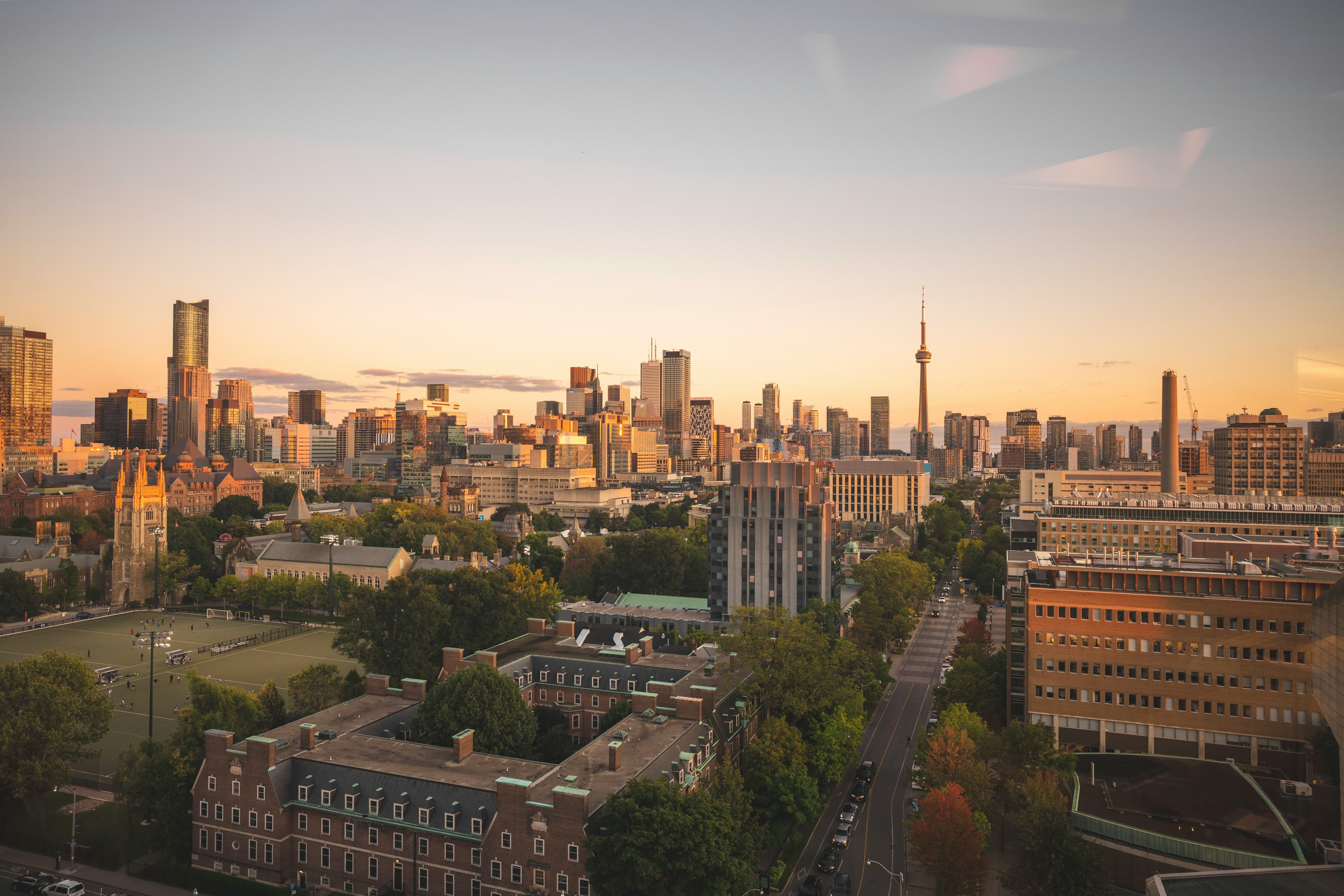
The University of Toronto ranks #25 globally — Canada's highest-ranked university and one of the top research institutions in North America. Its downtown St. George campus sits within walking distance of Bay Street (Toronto's financial district), Canada's largest hospital complex, and one of North America's fastest-growing technology ecosystems. The university has produced four Canadian prime ministers, ten Nobel laureates, and a disproportionate share of Canada's senior professionals in medicine, law, finance, and academia.
For international students, U of T offers something compelling: the prestige of a globally recognised research institution, in a city with some of the world's largest Korean, Chinese, and Indian communities, with a three-year Post-Graduation Work Permit and a documented Express Entry pathway to permanent residency. It also offers Canada's most expensive undergraduate tuition fees and a grade distribution that surprises almost every student who arrives expecting the GPAs they earned in high school. This guide covers both sides honestly.
Rankings and reputation
The University of Toronto ranks #25 in the QS World University Rankings 2026 — the highest of any Canadian university and significantly higher than UBC (#38) or McGill (#111). In North America, it sits in the same tier as institutions like Johns Hopkins, Duke, and Northwestern — research-intensive universities that are not quite the Ivy League or MIT/Stanford but are genuinely elite by any measure.
U of T's subject-level strengths are particularly notable in several disciplines:
| Subject | QS Subject Ranking 2026 |
|---|---|
| Computer Science and IT | Top 15 globally |
| Education | Top 20 globally |
| Medicine | Top 15 in North America |
| Engineering | Top 40 globally |
| Accounting and Finance | Top 30 globally |
| Social Sciences and Management | Top 30 globally |
| Arts and Humanities | Top 30 globally |
The Vector Institute for Artificial Intelligence — a world-leading AI research centre affiliated with U of T and housed adjacent to the campus — has positioned Toronto as one of the global centres for machine learning research, attracting Geoffrey Hinton (known as the "Godfather of AI" and 2024 Nobel laureate in physics) and dozens of other leading researchers. For students interested in AI and machine learning specifically, U of T's research environment is comparable to Stanford and MIT.
The three campuses: which one actually matters
This is the most important piece of information for prospective international students that most university guides bury or skip entirely.
The University of Toronto has three separate campuses:
| Campus | Location | Character | Distance to Downtown |
|---|---|---|---|
| St. George (UTSG) | Downtown Toronto (Bloor/University) | Main research campus; most selective; most international recognition | 0 km — in downtown |
| Mississauga (UTM) | Mississauga suburb | Smaller; more teaching-focused; less competitive admission | 27 km west |
| Scarborough (UTSC) | Scarborough suburb | Smaller; niche programs; co-op-heavy; more affordable area | 23 km east |
When employers, graduate schools, and immigration authorities reference "University of Toronto," they mean all three campuses — degrees from all three say "University of Toronto." However:
- Employer recognition: St. George graduates have stronger proximity to Bay Street recruitment and Toronto's main campus alumni networks
- Research access: The Vector Institute, hospital affiliations, and research labs are primarily at St. George
- Admission competitiveness: UTSG is the most selective; UTM and UTSC admit students who do not qualify for UTSG, sometimes in the same program
- Cost of living: St. George is in the most expensive part of Toronto; Mississauga and Scarborough have lower accommodation costs
For international students: Unless your program is only available at UTM or UTSC, or unless cost of living is a decisive factor, the St. George campus is what most people intend when they say they want to study at the University of Toronto.
ℹ️ Check which campus your program is offered at before applying
Some programs at U of T exist at all three campuses with similar names but different admission thresholds, faculty composition, and campus character. Computer Science is offered at all three campuses. Apply specifically to the campus you want — admission to one campus does not automatically transfer to another. If your first choice is St. George, apply to St. George specifically.
Programs and tuition fees
U of T's international student tuition is the highest of any major Canadian university — particularly for engineering and computer science programs, which have faced significant fee increases in recent years.
Undergraduate annual fees (international students, 2026)
| Program | Annual Fee (CAD) | Duration | Total Tuition |
|---|---|---|---|
| Engineering (all disciplines) | $60,000–$65,000 | 4 years | $240,000–$260,000 |
| Computer Science | $52,000–$58,000 | 4 years | $208,000–$232,000 |
| Commerce / Business | $52,000–$57,000 | 4 years | $208,000–$228,000 |
| Arts and Science (humanities) | $40,000–$46,000 | 4 years | $160,000–$184,000 |
| Life Sciences / Biological Sciences | $45,000–$50,000 | 4 years | $180,000–$200,000 |
| Architecture | $45,000–$52,000 | 4 years | $180,000–$208,000 |
| Music | $36,000–$40,000 | 4 years | $144,000–$160,000 |
U of T Engineering at CAD $60,000–$65,000/year for international students is the most expensive engineering undergraduate program in Canada. Over four years, total tuition exceeds CAD $240,000. Compare this to engineering at McGill (approximately CAD $22,000–$26,000/year) or the University of Alberta (approximately CAD $26,000–$32,000/year).
⚠️ U of T Engineering tuition is Canada's highest — compare before committing
At CAD $60,000–$65,000/year, the University of Toronto charges approximately 2.5–3× more for international engineering students than McGill University or the University of Alberta for comparable programs. The U of T engineering degree carries stronger employer recognition in Toronto — but whether that premium justifies the additional CAD $130,000–$150,000 in total tuition depends significantly on your career plan and financial situation. University of Waterloo's engineering programs, at approximately CAD $52,000–$58,000/year with co-op work terms, produce strong career outcomes at a lower total cost.
Postgraduate fees (international students, 2026)
| Program | Annual Fee (CAD) | Duration | Total Tuition |
|---|---|---|---|
| MBA (Rotman School) | $58,000–$65,000/year | 2 years | $116,000–$130,000 |
| JD (Faculty of Law) | $40,000–$48,000/year | 3 years | $120,000–$144,000 |
| Master of Engineering (MEng) | $32,000–$40,000/year | 1–2 years | $32,000–$80,000 |
| MSc Computer Science | $28,000–$35,000/year | 2 years | $56,000–$70,000 |
| MSc Data Science / AI | $28,000–$35,000/year | 2 years | $56,000–$70,000 |
| Master of Teaching | $22,000–$26,000/year | 2 years | $44,000–$52,000 |
| PhD (with funding) | $0 (typically funded) | 4–5 years | $0 |
Rotman School of Management (U of T's MBA) is Canada's highest-ranked MBA program — the total program cost of CAD $116,000–$130,000 is comparable to top-tier US MBA programs, which reflects its ambition to compete with schools like Wharton and Booth for talent.
PhD programs at U of T are typically funded — tuition is covered and students receive a living stipend (approximately CAD $20,000–$30,000/year depending on department). For research-focused students, U of T's doctoral programs represent genuine value.
Entry requirements
Undergraduate entry
U of T's St. George campus is among the most selective undergraduate programs in Canada for international students.
| Program | Required Grade (equivalent) | Korean Suneung | Indian CBSE (Class 12) |
|---|---|---|---|
| Engineering | 93%+ average | 1등급 | 92%+ aggregate |
| Computer Science | 92%+ average | 1등급 | 90%+ |
| Commerce | 90%+ average | 1등급 | 88%+ |
| Life Sciences | 88%+ average | 1–2등급 | 85%+ |
| Humanities / Arts | 80–85%+ average | 2등급 | 78%+ |
Postgraduate entry
- Strong undergraduate degree in a relevant field
- GPA: Minimum 3.3 (B+) for most programs; competitive programs want 3.7+ (A-)
- Rotman MBA: Minimum GMAT 550+ (average admitted class: 660–690)
- Law (JD): Strong undergraduate GPA + LSAT score
English requirements
| Program | IELTS Overall | IELTS Min Band | PTE Academic |
|---|---|---|---|
| Most undergraduate | 6.5 | 6.5 | 60 |
| Most postgraduate | 7.0 | 6.5 | 65 |
| Law (JD) | 7.0 | 7.0 | 65 |
| Medicine | 7.0 | 7.0 | 65 |
U of T uses a minimum band score requirement of 6.5 across all four IELTS skills — slightly stricter than some other Canadian universities that accept 6.0 in individual skills.
Scholarships
The Lester B. Pearson International Scholarship
The Lester B. Pearson Scholarship is one of the most prestigious international undergraduate scholarships in Canada. It covers:
- Full tuition for four years
- Books and incidental fees
- Accommodation (full residential costs)
- Living stipend
Approximately 37 students are selected globally each year from thousands of applications. Eligibility requires:
- Nomination by your secondary school
- Outstanding academic achievement
- Demonstrated leadership and community impact
The application requires both school nomination and a separate application to U of T with essays describing your vision and achievements. The deadline is typically November for entry the following September.
Other major scholarships
| Scholarship | Value | Who Can Apply |
|---|---|---|
| President's Scholars of Excellence | CAD $30,000/year (up to 4 years) | Exceptional incoming international undergraduates; very competitive |
| University of Toronto Scholars Program | CAD $5,000–$15,000 | High-achieving international students; based on admission average |
| Rotman Graduate Fellowship | CAD $15,000–$25,000 | MBA applicants with strong profiles |
| Faculty of Law scholarships | Varies | Law applicants with strong academic records |
| Research assistantships (grad) | Funding + stipend | Graduate students in research roles |
For most international students, the Pearson and President's Scholars programs are highly competitive. The Scholars Program offers more accessible partial funding (typically CAD $5,000–$10,000 per year) for strong academic entrants.
The GPA reality at U of T
This is the section every guide should include and most don't.
The University of Toronto has a reputation — well-documented in Canadian academic circles — for grade deflation. The average GPA in competitive programs like Computer Science, Engineering, and Life Sciences at UTSG is typically 0.3–0.5 GPA points lower than the same student would achieve at most other Canadian universities.
What this means practically:
- A student who earned 90% averages in high school may find themselves achieving a 3.2–3.4 GPA at U of T rather than the 3.7–3.8 GPA they might expect
- This affects graduate school admission: some competitive graduate programs weigh U of T GPAs against the known grade deflation, but many use raw GPA cutoffs
- This does not mean U of T graduates are weaker — employers and graduate schools with U of T experience understand this pattern — but it requires adjustment of expectations upon arrival
💡 How to manage U of T grade deflation
Know this before you arrive. The adjustment from high school top-of-class to university mid-range is sharper at U of T than at most North American universities. Students who succeed at U of T typically: attend office hours regularly, form study groups early in their programs, use U of T's writing centres and tutoring services, and choose courses strategically rather than taking the most prestigious sections of each course. Grade inflation is not coming — the workload is designed to differentiate students across the full GPA range.
Campus and downtown Toronto
St. George campus
U of T's St. George campus occupies a significant chunk of downtown Toronto between Bloor Street, College Street, and Queen's Park. The campus architecture is a striking mix:
- University College (1859): Gothic Revival — among North America's most beautiful 19th-century academic buildings
- Hart House (1919): Gothic Revival; student centre with dining, gym, and cultural events
- Robarts Library (1973): A famous piece of Brutalist architecture, nicknamed "Fort Book" by students — polarising but iconic
- Bahen Centre for Information Technology: Modern building housing Computer Science and Engineering
The campus is physically embedded in downtown Toronto in a way that few major universities globally can match. There is no clear boundary between campus and city — walking south from the Robarts Library puts you in the middle of Chinatown within five minutes; walking north takes you to Bloor Street's Yorkville shopping district.
What's within walking distance
| Destination | Distance from St. George campus |
|---|---|
| Bay Street (financial district) | 15 min walk |
| Toronto General Hospital / UCLH equivalent | 5 min walk |
| SickKids (Hospital for Sick Children) | 5 min walk |
| Koreatown (Bloor West) | 10 min walk |
| Chinatown (Spadina/Dundas) | 10 min walk |
| Kensington Market | 15 min walk |
| ROM (Royal Ontario Museum) | 5 min walk |
| MaRS Discovery District (tech hub) | 5 min walk |
The proximity to Bay Street is the most practically important factor for finance, consulting, and law students. U of T students can attend employer information sessions, networking events, and interviews in downtown Toronto without the 30–45 minute commute that students at outer campus universities face.
Living costs in Toronto near St. George
Toronto's housing market has become severely constrained. Living near the St. George campus — central Toronto — means paying some of the highest student rents in Canada.
| Accommodation | Monthly Cost (CAD) | Notes |
|---|---|---|
| On-campus college residence | $1,100–$1,700 | Includes meals; competitive allocation |
| Shared room, Annex neighbourhood | $1,300–$1,800 | Walking distance; popular with students |
| Shared room, Harbord Village | $1,200–$1,700 | Quieter; close to campus |
| Shared room, Kensington Market | $1,100–$1,600 | Eclectic neighbourhood; affordable end |
| Shared room, Zone 2 (commute) | $900–$1,300 | 30–45 min subway; saves $300–$500/month |
| Expense | Monthly (CAD) | Notes |
|---|---|---|
| Rent (shared, central Toronto) | $1,300–$1,800 | Dominant cost |
| Groceries | $350–$420 | Kensington Market for produce; T&T for Asian goods |
| Transport (TTC Metropass) | $156/month | Unlimited TTC transit |
| Phone | $35–$50 | Competitive Canadian carriers |
| Dining out | $250–$350 | Toronto has excellent affordable Asian food |
| Miscellaneous | $150–$250 | |
| Monthly Total | $2,241–$3,026 | |
| Annual Total | $26,892–$36,312 |
Korean, Chinese, and Indian communities
Koreatown
Bloor West's Koreatown — centred on Bloor Street between Bathurst and Christie stations — is walking distance from the St. George campus. It has Korean restaurants (Korean barbecue, fried chicken, ramyun), Korean cafés, Korean grocery stores (Galleria Supermarket is the primary Korean supermarket in Toronto), Korean bakeries, and a concentrated Korean student and expat community. For Korean students at U of T, this proximity is genuinely convenient.
Chinatown
Spadina Avenue and Dundas Street — also walking distance from campus — form the heart of Toronto's Chinatown. Chinese (primarily Cantonese-origin) grocery stores, dim sum restaurants, and Chinese-language services are concentrated here. T&T Supermarket (the dominant Chinese-Canadian grocery chain) has multiple locations accessible from campus. Markham's Pacific Mall — the largest indoor Asian shopping mall in North America — is 40 minutes by transit and worth knowing about for less frequent larger shopping trips.
Indian community
Toronto's Indian community is primarily concentrated in Brampton and Mississauga (30–40 minutes by transit from St. George). Gerrard India Bazaar, closer to campus in the east end, has Indian grocery stores and restaurants. Harris Park (Parramatta equivalent) is in Mississauga — further but accessible on weekends.
Post-study outcomes
PGWP and Express Entry
U of T graduates from 2-year or longer programs receive a 3-year Post-Graduation Work Permit — the maximum PGWP duration. Combined with Canadian work experience at U of T's employer-connected city, this gives one of the strongest starting positions for Express Entry among any Canadian university graduate.
Typical pathway for a U of T CS or Engineering master's graduate:
- 2-year master's → 3-year PGWP
- Work in tech or engineering in Toronto for 12 months
- Canadian Experience Class EOI → CRS score competitive
- Receive invitation; apply for PR
- Total from starting master's: approximately 3.5–4 years
Key employer connections
U of T's downtown location and research reputation create direct employer pipelines:
| Sector | Key Employers Recruiting from U of T |
|---|---|
| Technology | Google, Meta, Amazon, Shopify, TD Bank tech, RBC Ventures |
| Finance | Goldman Sachs, TD Securities, RBC Capital, Scotiabank, Big Four |
| Consulting | McKinsey, BCG, Bain, Deloitte, KPMG |
| Law | Stikeman Elliott, Osler, McCarthy Tétrault, Bay Street's top firms |
| Medicine / Research | Toronto General, SickKids, Mt. Sinai (world-class hospitals adjacent to campus) |
| AI / Research | Vector Institute, Radical Ventures, major tech AI labs |
The Vector Institute's co-location with U of T makes it the primary AI research hub in Canada, with direct connections to companies building AI products. U of T AI and ML graduates have among the strongest research placement rates in North America.
U of T vs University of Waterloo vs UBC
| Factor | U of T (#25) | Waterloo (~#150) | UBC (#38) |
|---|---|---|---|
| Global ranking | Best in Canada | Strongest in co-op | #2 in Canada |
| CS/Engineering | Top 15 globally | Top co-op pipeline | Top 40 globally |
| Co-op program | Limited (some programs) | 5–6 paid work terms | Available in some programs |
| Tuition (engineering) | CAD $60K–$65K/yr | CAD $52K–$58K/yr | CAD $45K–$52K/yr |
| Location | Downtown Toronto | Waterloo (small city) | Vancouver (very expensive) |
| AI/ML research | Vector Institute (world-leading) | Strong (Waterloo AI) | Strong (UBC AI) |
| PGWP (4-yr program) | 3 years | 3 years | 3 years |
| Indian community | Very large (Brampton nearby) | Moderate | Large (Surrey/Abbotsford) |
| Korean community | Active (Koreatown walking) | Small | Large (Burnaby, Coquitlam) |
Choose U of T over Waterloo if: Global research prestige and Bay Street employer access are priorities; you want to be in downtown Toronto; AI/ML research at Vector Institute level is your goal; or law and medicine are your field (Waterloo has no law or medical school).
Choose Waterloo over U of T if: Co-op work terms with 5–6 paid employment placements during your degree are your priority (Waterloo co-op graduates often have 2+ years of Canadian work experience at graduation, shortening their PR timeline significantly); lower tuition matters; or you prefer a smaller university-town environment.
Choose UBC over both if: Vancouver's lifestyle and Pacific Asia proximity appeal; forestry, marine sciences, or environmental programs are your field; lower tuition than U of T matters; or the UBC research environment in your specific field is stronger.
How to apply
Application portal: U of T accepts applications through the Ontario Universities' Application Centre (OUAC) for undergraduate programs and directly through the School of Graduate Studies portal for postgraduate programs.
Key dates for September 2027 entry:
| Action | Timeline |
|---|---|
| Lester B. Pearson Scholarship nomination | Request from school by October 2026 |
| Pearson Scholarship application deadline | November 2026 (verify exact date) |
| OUAC undergraduate application opens | October 2026 |
| OUAC undergraduate deadline | January 15, 2027 |
| Graduate program applications (varies) | November 2026–February 2027 |
| Receive offers | February–May 2027 |
| Accept offer and arrange study permit | As soon as offer received |
| Arrive in Toronto | Late August 2027 |
| Orientation and first day | September 2027 |
The study permit application should be submitted as soon as you receive your letter of acceptance. Given Canada's study permit cap and processing times, apply at least 12 weeks before your intended start date. Indian, Chinese, and other SDS-eligible nationalities should use the Student Direct Stream for faster processing.
Frequently asked questions
Is U of T or Waterloo better for software engineering? Both produce excellent software engineers with strong Canadian employment outcomes. The career outcome difference is less about which university and more about which co-op placements you land (Waterloo) or which research lab you join (U of T Vector Institute). Waterloo co-op graduates typically have more immediately ready professional experience at graduation. U of T graduates have stronger research credentials and access to Toronto's financial technology sector. For students who want to work at Google or Microsoft in Vancouver/Toronto and stay in Canada: both work. For students who want research careers in AI: U of T is stronger.
What is the Annex neighbourhood like for international students? The Annex (between Bloor, Spadina, Bathurst, and Dupont) is one of Toronto's most pleasant student-friendly neighbourhoods — Victorian semi-detached houses converted to student rentals, accessible cafés, bookstores, and restaurants. It is popular with U of T graduate students. Rents are competitive for central Toronto (CAD $1,300–$1,700/month for a shared room) but have increased significantly since 2020.
Does U of T's grade deflation affect graduate school admission? Many North American graduate schools are aware of U of T's grade distribution patterns. Competitive programs at places like Harvard, MIT, and U of T's own graduate school factor this into assessment. However, not all programs make this adjustment explicitly — some use raw GPA cutoffs that work against U of T undergraduates. The practical advice is to be aware of this from your first semester, maintain the highest GPA you can, and contextualise your U of T GPA in any application personal statement or interview.
Is Toronto safe for international students? Toronto is generally safe by North American city standards and consistently ranks among Canada's safest major cities. The St. George campus area — downtown Toronto — experiences the petty crime (pickpocketing, bicycle theft) typical of any major urban centre. The university's campus police and community safety resources are well-resourced. International students consistently report feeling safe in the campus area.
Can I stay in Canada after graduating from U of T? Yes — a PGWP gives you up to 3 years of open Canadian work rights. After 12 months of skilled Canadian work experience, you are eligible for Express Entry's Canadian Experience Class. U of T's Bay Street employer connections and Toronto tech ecosystem make finding skilled employment within the PGWP period more accessible than at many other Canadian institutions.
🇨🇦 Compare University of Toronto with every Canadian university
See tuition, graduate salaries, and payback periods for U of T vs UBC, McGill, Waterloo, and all other Canadian universities.
📋 Build your Canadian study permit timeline
Set your U of T intake date — September is the main intake — and get a step-by-step checklist from IELTS to study permit to PGWP.
Tuition fees are based on the University of Toronto's published 2026 international student fee schedules. Fees increase annually and vary by program and campus — verify current rates at future.utoronto.ca before applying. The Lester B. Pearson Scholarship deadlines and amounts change annually; check the official U of T scholarship page for current information.