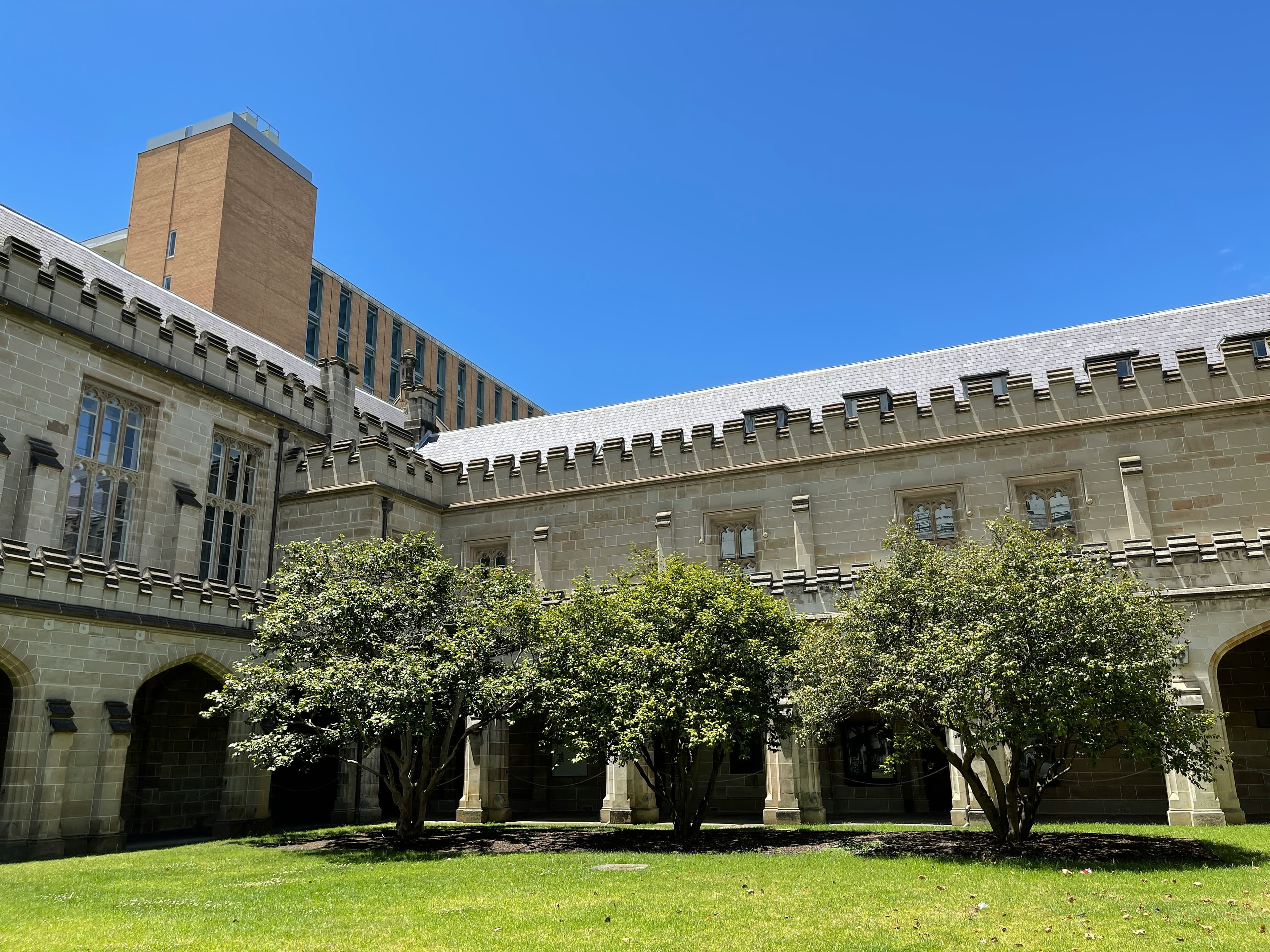
The University of Melbourne is Australia's highest-ranked university and one of the top 15 universities in the world. For international students from Asia, it represents the clearest combination of global academic prestige, a proven permanent residency pathway, and one of the world's most liveable cities. It also has a degree structure — the Melbourne Model — that confuses more international students than any other aspect of the university, and which significantly affects both the cost and the timeline of your study.
This guide covers everything: rankings, degree structure, tuition by program, entry requirements from Korea, India, and China, scholarship availability, life near campus, and what happens after you graduate with a Melbourne degree and a four-year post-study work visa.
Rankings and global reputation
The University of Melbourne ranks #13 in the QS World University Rankings 2026 — the highest of any Australian university and higher than every university in Canada, and most in the UK outside Oxford, Cambridge, Imperial, and UCL.
The university consistently appears in the top 10 globally for several subject areas:
| Subject Area | QS Subject Ranking 2026 |
|---|---|
| Education | Top 10 globally |
| Law | Top 15 globally |
| Veterinary Science | Top 15 globally |
| Medicine | Top 20 globally |
| Architecture | Top 25 globally |
| Engineering and Technology | Top 50 globally |
| Computer Science | Top 50 globally |
| Accounting and Finance | Top 50 globally |
For students from South Korea, India, and China, the Melbourne brand carries genuine weight with employers both in Australia and at home. Australian Graduate Survey data consistently shows Melbourne graduates among the highest earners within three years of graduation.
The Melbourne Model: what makes it different
This is the section most university guides skip. The Melbourne Model is the degree structure introduced in 2008 that makes the University of Melbourne fundamentally different from every other Australian university. Understanding it before you apply is essential — it directly affects how long you study and how much you pay.
The core idea
At most Australian universities, you study engineering, law, or medicine as an undergraduate degree and graduate as a professional. At Melbourne, most professional disciplines are delivered at postgraduate level. Undergraduate degrees are intentionally broad — you study across disciplines rather than specialising immediately.
What this means in practice
| Profession | Other Australian Universities | University of Melbourne |
|---|---|---|
| Lawyer | 4-year Bachelor of Laws (LLB) | 3-yr bachelor's (any field) + 3-yr Juris Doctor = 6 years |
| Doctor | Direct-entry 5–6yr MBBS | 3-yr bachelor's (Biomedicine/Science) + 4-yr MD = 7 years |
| Architect | 5-yr Bachelor/Master of Architecture | 3-yr bachelor's + 2-yr Master of Architecture = 5 years |
| Engineer | 4-yr Bachelor of Engineering | 3-yr bachelor's (Science/Environments) + 2-yr Master of Engineering = 5 years |
| Teacher | 4-yr Bachelor of Education | 3-yr bachelor's (any) + 2-yr Master of Teaching = 5 years |
⚠️ Budget for 5–6 years if targeting law, medicine, or engineering
International students from Korea and India are often accustomed to direct-entry professional degrees. At Melbourne, law, medicine, and engineering all require a bachelor's degree followed by a professional postgraduate degree. If you arrive expecting a 4-year engineering undergraduate program, you will find it does not exist in the traditional sense at Melbourne. Plan and budget accordingly before applying.
The undergraduate degrees that do exist
Melbourne's undergraduate programs are structured around a major plus breadth subjects outside your major:
- Bachelor of Arts (3 years)
- Bachelor of Commerce (3 years)
- Bachelor of Science (3 years)
- Bachelor of Biomedicine (3 years)
- Bachelor of Design (3 years)
- Bachelor of Environments (3 years) — includes some engineering and planning pathways
- Bachelor of Fine Arts (3 years)
- Bachelor of Music (3 years)
These are excellent degrees in their own right. A Bachelor of Commerce from Melbourne is one of the most respected undergraduate business credentials in Australia. But they are generalist by design — the professional depth comes at the postgraduate stage.
Programs and tuition fees
Undergraduate annual fees (international students, 2026)
| Program | Annual Fee (AUD) | Duration | Total Tuition |
|---|---|---|---|
| Bachelor of Arts | $38,912 | 3 years | $116,736 |
| Bachelor of Commerce | $47,480 | 3 years | $142,440 |
| Bachelor of Science | $44,736 | 3 years | $134,208 |
| Bachelor of Biomedicine | $44,736 | 3 years | $134,208 |
| Bachelor of Design | $42,240 | 3 years | $126,720 |
| Bachelor of Environments | $44,736 | 3 years | $134,208 |
Graduate/postgraduate annual fees (international students, 2026)
| Program | Annual Fee (AUD) | Duration | Total Tuition |
|---|---|---|---|
| Master of Engineering | $49,952 | 2 years | $99,904 |
| Master of Information Technology | $49,952 | 1.5–2 years | $74,928–$99,904 |
| Master of Commerce | $47,480 | 1.5–2 years | $71,220–$94,960 |
| Master of Social Work | $38,016 | 2 years | $76,032 |
| Master of Teaching | $37,000 | 2 years | $74,000 |
| Master of Architecture | $46,000 | 2 years | $92,000 |
| Juris Doctor (Law) | $52,000 | 3 years | $156,000 |
| Doctor of Medicine (MD) | $92,000+ | 4 years | $368,000+ |
| PhD (with RTP scholarship) | $0 (fees waived) | 3.5–4 years | $0 |
ℹ️ PhD and research master's fees are almost always waived
The Research Training Program (RTP) is a federal government scholarship that covers 100% of tuition fees for PhD and research master's students at Australian universities. Competition is real but if you are admitted to a Melbourne PhD program, you will almost certainly receive the fee waiver — plus a living stipend of AUD $36,500/year. If research is your path, Melbourne's PhD programs represent exceptional value relative to the cost of coursework degrees.
Entry requirements
Academic requirements
Melbourne's entry requirements for international students are assessed against Australian ATAR equivalents. The conversion from your country's grading system is done by the university automatically.
Undergraduate (approximate equivalents):
| Program | Approx. ATAR | Korean Equivalent | Indian (CBSE) | Chinese Gaokao |
|---|---|---|---|---|
| Bachelor of Arts | 80+ | Suneung 2–3등급 | 70%+ (Class 12) | Competitive, varies by province |
| Bachelor of Commerce | 90+ | Suneung 1–2등급 | 80%+ (Class 12) | High; competitive |
| Bachelor of Science | 88+ | Suneung 1–2등급 | 78%+ (Class 12) | High |
| Bachelor of Biomedicine | 96+ | Suneung 1등급 | 90%+ (Class 12) | Very high |
Graduate/postgraduate (general):
- A completed bachelor's degree from a recognised university
- Minimum GPA equivalent to 65% or above (varies by program; competitive programs require 70%+)
- Relevant undergraduate discipline for professional programs (e.g., science or biomedicine for MD consideration)
English language requirements
| Program Level | IELTS Overall | IELTS Min Band | PTE Academic |
|---|---|---|---|
| Most undergraduate | 6.5 | 6.0 | 58 |
| Most graduate coursework | 6.5–7.0 | 6.0–6.5 | 58–65 |
| Law (JD), Medicine (MD) | 7.0 | 6.5 | 65 |
| Research degrees (PhD) | 6.5 | 6.0 | 58 |
Melbourne accepts IELTS Academic, PTE Academic, TOEFL iBT (minimum 79), and Cambridge C1 Advanced (minimum 185). Results must be within two years of your application date.
Scholarships and financial support
Melbourne is notably less generous with automatic merit scholarships for international undergraduates compared to some other Go8 universities. Monash University, for example, offers an automatic AUD $15,000/year scholarship for qualifying international undergraduates — Melbourne does not have a direct equivalent at this scale.
Available scholarships for international students
| Scholarship | Value | Who Can Apply |
|---|---|---|
| Melbourne Research Scholarship | Full tuition waiver + AUD $36,500/year stipend | PhD and research master's applicants (very competitive) |
| Graduate Research International Scholarship | Full tuition waiver | PhD applicants; competitive |
| Faculty of Engineering International Scholarship | AUD $10,000 one-off | Master of Engineering students with strong academic record |
| Melbourne School of Design Scholarship | AUD $10,000 one-off | Master of Architecture; competitive |
| Various faculty merit bursaries | AUD $3,000–$8,000 | Varies; check faculty pages |
| Australia Awards | Full tuition + stipend | Students from eligible developing countries |
The honest reality: for international undergraduate students at Melbourne, significant scholarship funding is rare. Most students pay full international tuition. If scholarship availability is a primary decision factor, Monash University (Go8, ranked #36 globally, also in Melbourne) offers better automatic scholarship support while providing a comparable Melbourne lifestyle and the same 4-year 485 visa.
Campus and location
The Parkville campus
Melbourne's main campus is in Parkville, approximately 3 kilometres north of the Melbourne CBD. It is one of the most beautiful university campuses in Australia — a sandstone and red-brick precinct that houses the majority of the university's faculties, libraries, and student services.
Key campus landmarks:
- The Old Quad — Melbourne's most photographed building; the heart of the Parkville campus
- Baillieu Library — the largest library in the Southern Hemisphere, open 24 hours during exam periods
- Student Union Building — shops, food, student clubs, and welfare services
- Melbourne Connect — the university's innovation precinct in Carlton, home to tech companies and research commercialisation
The Southbank campus houses the Melbourne Conservatorium of Music and parts of the Faculty of Fine Arts and Music — a short walk or tram ride from Parkville.
Carlton and the surrounding suburbs
Carlton is Melbourne's university suburb — directly adjacent to the Parkville campus. It has:
- High density of shared student housing at AUD $1,000–$1,500/month per room
- Melbourne's Chinatown begins at the southern edge of Carlton (Lygon Street)
- Large Korean student community concentrated in Carlton, Swanston Street corridor, and Hawthorn
- Excellent tram connections to the city (Route 1, 8, 19, 57, 58, 59)
- ALDI and Coles within walking distance of most student accommodation
Fitzroy and Brunswick (adjacent to Carlton) are increasingly popular with students seeking slightly cheaper rent (AUD $900–$1,300/month per room) with easy tram access to campus.
| Location | Approx. Weekly Rent (shared room) | Walk/Tram to Campus |
|---|---|---|
| Carlton (walking distance) | AUD $320–$420 | 5–15 min walk |
| Fitzroy | AUD $280–$380 | 10–20 min tram |
| Brunswick | AUD $250–$340 | 15–25 min tram |
| CBD | AUD $350–$480 | 15–20 min tram |
| Hawthorn (Korean community hub) | AUD $270–$360 | 20–30 min tram |
Life in Melbourne as an international student
Melbourne has the largest international student population of any Australian city. Approximately 200,000 international students study in Melbourne at any given time, and the city's culture is genuinely shaped by this diversity.
Korean community: Melbourne has one of Australia's largest Korean communities outside of the inner-city Korean hubs. Hawthorn is particularly well-known as a Korean student hub — Korean restaurants, convenience stores, and study cafés are concentrated along Glenferrie Road. Box Hill has a growing Korean community with well-established Korean supermarkets.
Indian community: Melbourne's Indian community is large and spread across the inner north and west. Dandenong, in Melbourne's southeast, has one of Australia's largest South Asian communities. Indian grocery stores are accessible in most suburban centres. Indian student associations at Melbourne are among the most active in Australia.
Chinese community: Carlton's Chinatown is the oldest in the Southern Hemisphere. The Chinese student community at Melbourne is substantial — approximately 15–20% of international enrolment is from mainland China. WeChat study groups, Chinese student associations, and Mandarin-speaking peer support networks are well-established.
Part-time work: Melbourne's hospitality industry is the primary employer for international students in their first year. The café culture is genuine — Melbourne has more cafés per capita than almost any city in the world — and café work at AUD $24.10–$28/hour (with weekend penalty rates) is accessible within 2–4 weeks of arriving for students with basic customer service experience.
Post-study outcomes: the Go8 advantage
Graduating from the University of Melbourne triggers one of the most valuable post-study visa arrangements available to international students globally.
Subclass 485 (Temporary Graduate Visa) for Melbourne graduates:
| Degree Level | Post-Study Visa Duration |
|---|---|
| Bachelor's degree | 4 years |
| Graduate certificate / diploma | 4 years |
| Master's (coursework) | 4 years |
| Master's (research) | 4 years |
| PhD | 4 years |
Four years of unrestricted Australian work rights. No employer sponsorship. No minimum salary. Full right to work in any occupation anywhere in Australia.
Employment outcomes: Melbourne's graduate employment rate consistently ranks among the top three in Australia. Graduate starting salaries for key fields (2025 data):
| Field | Average Starting Salary (AUD) |
|---|---|
| Engineering (Master of Engineering) | $78,000–$92,000 |
| Information Technology (MIT) | $75,000–$88,000 |
| Commerce / Finance | $68,000–$82,000 |
| Law (JD — first associate role) | $80,000–$110,000 |
| Social Work | $70,000–$78,000 |
| Teaching | $72,000–$80,000 (state award rate) |
PR pathway from Melbourne: The combination of a Melbourne degree (high academic recognition), strong graduate salary, and 4-year 485 visa positions graduates well for state nomination. Victoria's nomination scheme (subclass 190) regularly receives applications from Melbourne graduates in engineering, IT, healthcare, and education.
University of Melbourne vs other Go8 in Melbourne: Monash
Prospective students frequently compare Melbourne and Monash — both are Go8 universities in Melbourne, both produce the 4-year 485 visa, and both have strong graduate outcomes. The honest comparison:
| Factor | University of Melbourne | Monash University |
|---|---|---|
| QS ranking | #13 | #36 |
| Location | Parkville (CBD-adjacent) | Clayton (27km from CBD) |
| Undergraduate scholarships | Limited for international | AUD $15,000/year automatic |
| Engineering pathway | 5 years (bachelor's + master's) | 4 years (direct-entry bachelor's) |
| Nursing | Not available at bachelor's | Strong nursing faculty |
| 485 visa | 4 years (Go8) | 4 years (Go8) |
| Student community | Very large, very diverse | Large; strong Malaysian/Singaporean community |
Choose Melbourne if: Prestige and global ranking matter for your career or home country employer; you are targeting law, medicine, or arts; you want to live in or near the Melbourne CBD; the Melbourne brand is specifically valued in your field.
Choose Monash if: You want direct-entry undergraduate engineering without the 5-year Melbourne pathway; automatic scholarship funding is important to your budget; Nursing is your target field; you prefer a more suburban campus environment.
How to apply
Timeline for February 2027 intake:
| Deadline | Action |
|---|---|
| July–August 2026 | Submit application via Melbourne's International Students application portal |
| August–October 2026 | Receive conditional offer — submit English test scores and transcripts |
| October–November 2026 | Receive unconditional offer — accept and pay deposit (AUD $2,000–$5,000) |
| November 2026 | Receive Confirmation of Enrolment (CoE) |
| November–December 2026 | Apply for Student visa (subclass 500) via ImmiAccount |
| January 2027 | Book flights; arrange accommodation |
| Late February 2027 | Semester 1 begins |
Applications for July 2026 intake (Semester 2): Apply by March–April 2026. Fewer places available for most programs.
Application documents required:
- Academic transcripts (certified and translated if not in English)
- English language test results (IELTS, PTE, TOEFL, or Cambridge)
- Personal statement (for graduate programs)
- References (for graduate research programs)
- Portfolio (for Design, Fine Arts, Architecture programs)
Application fee: AUD $100 for most programs; some are free. Waived for applicants from certain partner institutions.
Frequently asked questions
Is the University of Melbourne better than UNSW or Sydney for international students? It depends on your field and priorities. Melbourne ranks higher globally (#13 vs #18 and #19) and has stronger law, education, and arts programs. UNSW is stronger in engineering technology and has direct-entry 4-year engineering undergraduate programs. For IT and business, all three are comparable. The Melbourne Model adds complexity for professional degree pathways that UNSW and Sydney do not have.
Can I get into Melbourne with an IELTS of 6.0? Generally no for direct entry. Most Melbourne programs require IELTS 6.5 overall with no band below 6.0. Some programs require 7.0. If your current score is 6.0, explore Melbourne's English language programs (run through Melbourne Language Centre) as a pathway.
Is Melbourne safe for international students? Melbourne consistently ranks in global top 5 for liveability and personal safety. The Parkville campus area (Carlton, Fitzroy) is safe. As with all cities, general urban awareness applies — pickpocketing on public transport and in the CBD occurs occasionally. The university's security team operates 24/7 and a walk-home service is available for students late at night.
Does Melbourne accept PTE instead of IELTS? Yes. PTE Academic is accepted with a minimum score of 58 (equivalent to IELTS 6.5) for most programs and 65 (equivalent to IELTS 7.0) for competitive programs. PTE results are available within 48 hours, which can be advantageous for students with tight application deadlines.
What is the Melbourne campus like for Korean students? Melbourne has a substantial Korean student community. Hawthorn (accessible by tram from campus) is the main Korean hub for students. The Korean Students Association at Melbourne is one of the most active student organisations. Korean restaurants, convenience stores, and study cafés are well-established in Hawthorn and in Carlton near campus. Students from Seoul or Busan consistently report faster adjustment to Melbourne than to any other Australian city.
Can I apply for PR directly from a Melbourne master's degree? Not directly — permanent residency requires an additional visa step after graduation. The typical pathway: Melbourne master's degree → 4-year subclass 485 visa → skills assessment → Expression of Interest through SkillSelect → state nomination (subclass 190) or Skilled Independent invitation (subclass 189) → permanent residency. The full timeline from graduation to PR is typically 2–4 years depending on occupation and state nomination availability.
📊 See University of Melbourne's ROI vs other Go8 universities
Compare Melbourne's tuition, average graduate salary, and degree payback period against every other Australian university.
📋 Build your Melbourne application checklist
Set your intake date — February or July — and get a step-by-step timeline from IELTS booking to arrival day.
Fee figures are based on the University of Melbourne's published 2026 international student fee schedules. Fees increase annually — verify current rates at fees.unimelb.edu.au before applying. Entry requirements and scholarship availability are subject to change.