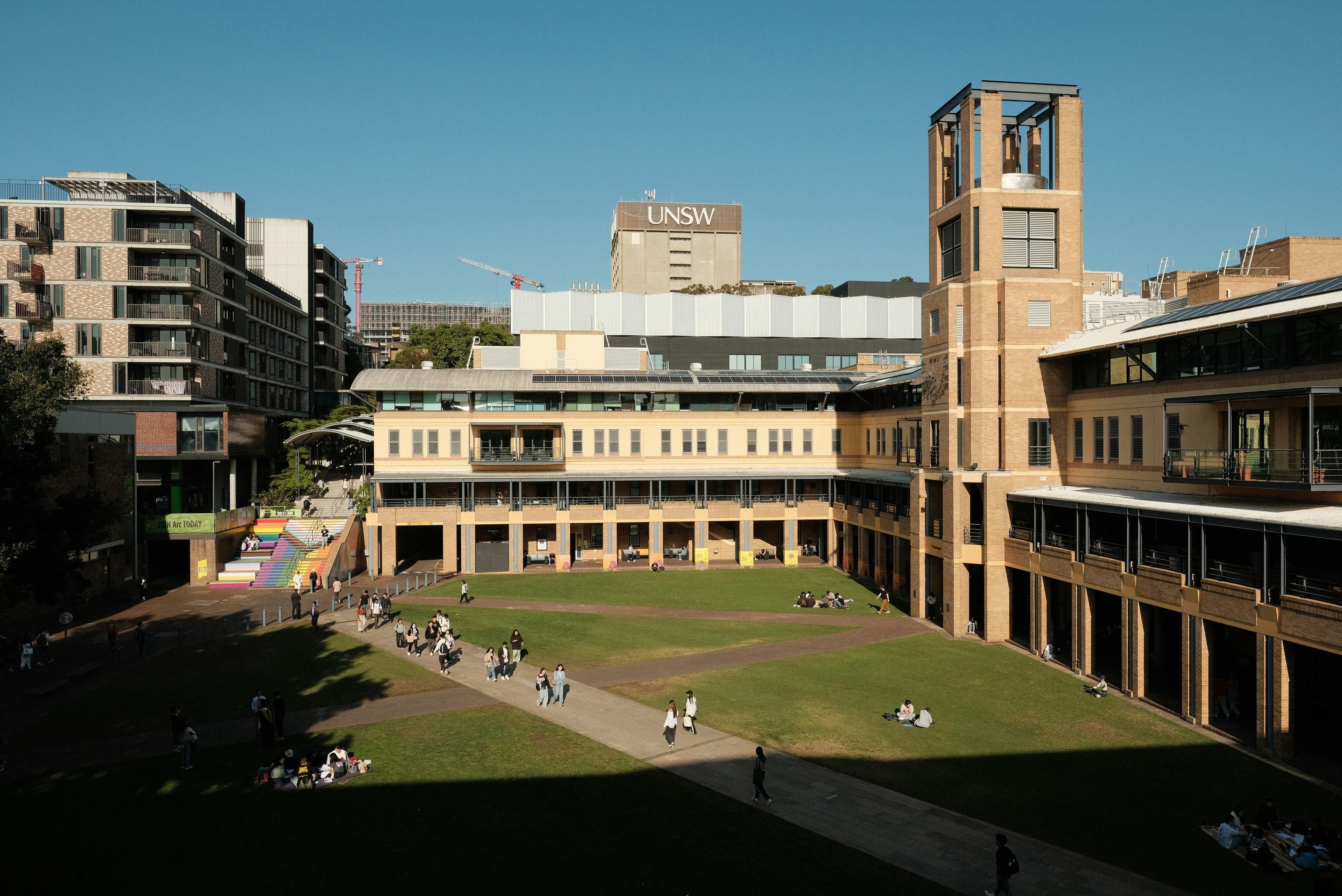
UNSW Sydney consistently ranks among the world's top 20 universities and is Australia's leading institution for engineering, computer science, and business. For international students from Korea, India, and Southeast Asia choosing between Australia's top universities, UNSW offers something the University of Melbourne does not: direct-entry four-year engineering undergraduate programs. In a country where most top-ranked institutions require a bachelor's degree followed by a separate postgraduate engineering qualification, UNSW's structure saves a year of study and a significant sum in tuition fees for students pursuing engineering or computer science careers.
This guide covers everything international students need to know about UNSW — programs, tuition, entry requirements, scholarships, life in Sydney's eastern suburbs, and what a UNSW degree means for your post-study visa and permanent residency pathway.
Rankings and global reputation
UNSW Sydney ranks #19 in the QS World University Rankings 2026 — placing it among the top 20 universities globally alongside Oxford, Cambridge, MIT, and a small group of elite institutions. In Australia, only the University of Melbourne (#13) ranks higher.
UNSW's subject-level rankings reflect particular strength in technical and professional disciplines:
| Subject | QS Subject Ranking 2026 |
|---|---|
| Engineering and Technology | Top 20 globally |
| Computer Science and Information Systems | Top 30 globally |
| Accounting and Finance | Top 30 globally |
| Law | Top 40 globally |
| Business and Management | Top 50 globally |
| Chemistry | Top 50 globally |
| Physics and Astronomy | Top 60 globally |
For students targeting engineering, IT, or finance careers, UNSW's subject-level rankings in these fields are among the strongest of any university in the Southern Hemisphere.
What makes UNSW different from other top Australian universities
Direct-entry engineering — the key structural advantage
The single most important practical difference between UNSW and the University of Melbourne for engineering-bound students is degree structure.
At the University of Melbourne, engineering is primarily delivered at postgraduate level. Students complete a three-year bachelor's degree (usually Science or Environments) and then a two-year Master of Engineering — a five-year pathway to professional accreditation. Total tuition: approximately AUD $235,000–$250,000 across five years.
At UNSW, the Bachelor of Engineering (Honours) is a direct-entry four-year undergraduate degree. Students graduate as accredited professional engineers after four years. Total tuition: approximately AUD $200,000 across four years.
The UNSW advantage: One year less study. Approximately AUD $50,000 less in tuition. One year earlier on the job market with a four-year post-study visa that starts running from the same graduation point.
For students from India, Korea, and China where engineering is traditionally an undergraduate qualification, UNSW's direct-entry engineering aligns with what your home country employers recognise — while adding the prestige of a global top-20 degree.
Business school with direct finance sector access
UNSW Business School is one of Australia's highest-ranked business faculties and sits at the edge of Sydney's CBD financial district — a practical proximity that matters for internships, industry events, and graduate recruitment. Goldman Sachs, JP Morgan, Macquarie Group, Commonwealth Bank, and the Big Four accounting firms all recruit directly from UNSW's business school.
The Australian Graduate School of Management (AGSM) — UNSW's flagship MBA program — consistently ranks among Australia's top two for executive education.
Research output and industry partnerships
UNSW is among Australia's most research-intensive universities. The Centre for Quantum Computation and Communication Technology at UNSW has produced breakthrough research that Microsoft has partnered with for commercial quantum computing development. The university's close relationships with industry — Google, Microsoft, KPMG, Cochlear, and others — translate to internship pipelines and graduate employment networks that directly benefit students.
Programs and tuition fees
Undergraduate annual fees (international students, 2026)
| Program | Annual Fee (AUD) | Duration | Total Tuition |
|---|---|---|---|
| Bachelor of Engineering (Honours) | $49,960 | 4 years | $199,840 |
| Bachelor of Computer Science | $47,940 | 3 years | $143,820 |
| Bachelor of Commerce | $47,940 | 3 years | $143,820 |
| Bachelor of Science | $43,980 | 3 years | $131,940 |
| Bachelor of Arts | $38,984 | 3 years | $116,952 |
| Bachelor of Laws (combined) | $49,960 | 5 years | $249,800 |
| Bachelor of Design (Architecture) | $44,960 | 3 years | $134,880 |
| Bachelor of Medical Studies (BMedSci) | $55,000 | 3 years | $165,000 |
The Bachelor of Engineering at AUD $49,960/year sits at the top of UNSW's fee schedule — reflecting both the engineering premium common across Australian universities and the laboratory and equipment costs embedded in the program. Across four years, the total international tuition is AUD $199,840.
Postgraduate annual fees (international students, 2026)
| Program | Annual Fee (AUD) | Duration | Total Tuition |
|---|---|---|---|
| Master of Engineering | $49,960 | 1.5–2 years | $74,940–$99,920 |
| Master of Information Technology | $47,940 | 1.5–2 years | $71,910–$95,880 |
| Master of Commerce | $47,940 | 1.5–2 years | $71,910–$95,880 |
| Master of Applied Finance | $47,940 | 1–1.5 years | $47,940–$71,910 |
| Juris Doctor (Law) | $52,000 | 3 years | $156,000 |
| Master of Architecture | $44,960 | 2 years | $89,920 |
| PhD (with RTP scholarship) | $0 (waived) | 3.5–4 years | $0 |
💡 Master of Applied Finance — UNSW's fastest postgraduate route to Sydney finance
UNSW's Master of Applied Finance is available as a one-year program for students with a quantitative undergraduate background. At approximately AUD $48,000 total tuition, it provides direct access to Sydney's financial sector — one of Asia-Pacific's largest — in the shortest timeframe of any UNSW postgraduate program. Graduates are recruited by investment banks, funds management firms, and the Big Four directly from this program.
Entry requirements
Academic requirements for undergraduate entry
UNSW assesses international qualifications directly without requiring a separate credential assessment. Indicative academic requirements:
| Program | Indian CBSE (Class 12) | Korean Suneung | Chinese Gaokao |
|---|---|---|---|
| Bachelor of Engineering | 85%+ aggregate | 1–2등급 | High; province-dependent |
| Bachelor of Computer Science | 82%+ aggregate | 1–2등급 | High |
| Bachelor of Commerce | 85%+ aggregate | 1–2등급 | High |
| Bachelor of Science | 80%+ aggregate | 2등급 | Competitive |
| Bachelor of Arts | 75%+ aggregate | 2–3등급 | Competitive |
For Indian students: Mathematics and Physics/Chemistry performance is particularly important for Engineering and Computer Science applications. UNSW looks at your top four or five subjects weighted for the program applied to.
Academic requirements for postgraduate entry
- A completed bachelor's degree in a relevant field from a recognised institution
- Minimum GPA equivalent to a UNSW credit average (65%+); competitive programs require distinction average (75%+)
- Master of Engineering typically requires an engineering or science undergraduate degree
- Master of Commerce: business, economics, or related undergraduate field
English language requirements
| Program | IELTS Overall | IELTS Min Band | PTE Academic |
|---|---|---|---|
| Most undergraduate | 6.5 | 6.0 | 58 |
| Most postgraduate | 6.5–7.0 | 6.0–6.5 | 58–65 |
| Law (JD) | 7.5 | 7.0 | 73 |
| Medicine (BMedSci) | 7.0 | 7.0 | 65 |
UNSW's Law program has the highest English requirement of any common UNSW program — IELTS 7.5 with no band below 7.0. If law is your goal, begin IELTS preparation well in advance.
Scholarships for international students
UNSW offers several scholarship streams for international students. Unlike Monash University's automatic merit scholarships, UNSW scholarships require a separate application in most cases.
| Scholarship | Value | Who Can Apply |
|---|---|---|
| UNSW Global Academic Award | Up to AUD $20,000 (one year) | All commencing international undergraduates who meet academic threshold — apply during admission |
| UNSW International Excellence Award | AUD $5,000–$15,000/year (up to 4 years) | High-achieving international applicants; separate application |
| Scientia PhD Scholarship | Full tuition + AUD $40,000/year stipend + AUD $10,000 career development | PhD research applicants; highly competitive |
| UNSW Engineering International Scholarship | AUD $10,000 one-off | Commencing international Engineering students with strong academic record |
| Faculty of Business scholarships | AUD $5,000–$15,000 | Various; check UNSW Business School international page |
The Global Academic Award is UNSW's most accessible scholarship for new international undergraduates — awarded based on academic merit with no separate application required beyond the admission form. The amount (up to AUD $20,000) covers approximately 40% of one year's tuition for engineering students. It is not renewable beyond first year.
For research candidates, the Scientia PhD Scholarship is exceptionally generous — full tuition, AUD $40,000/year living stipend, and career development funding. Competition is very high; typically requires a first-class honours or equivalent academic record and a strong research proposal.
Campus and location
Kensington campus
UNSW's main campus is in Kensington, approximately 7 kilometres southeast of the Sydney CBD. The campus is substantial — covering 38 hectares with over 100 buildings including lecture theatres, research facilities, libraries, student accommodation, and recreational facilities.
The campus has direct light rail connection to the CBD via the L2 Randwick line, with stops including UNSW High Street and UNSW Anzac Parade. The journey to Central Station takes approximately 25 minutes. Multiple bus routes provide additional connectivity.
Key campus features:
- Scientia Building — UNSW's flagship building and primary event venue
- UNSW Library — open 24 hours during examination periods; strong digital collections
- Roundhouse — student venue, events, dining
- Recreation Centre — gym, swimming pool, courts; accessible on student membership
- UNSW Village — on-campus residential college; approximately AUD $350–$480/week including meals
The Paddington campus houses the UNSW Art & Design faculty — a separate creative precinct in Sydney's inner east.
Eastern suburbs — living near UNSW
The suburbs surrounding UNSW's Kensington campus form one of Sydney's most desirable student precincts — close to the eastern beaches, well-served by public transport, and with a strong Asian food and community infrastructure.
| Suburb | Walk/Transport to Campus | Weekly Rent (shared room) | Character |
|---|---|---|---|
| Kensington | 5–15 min walk | AUD $340–$450 | Closest; heavily student-populated |
| Kingsford | 10 min walk | AUD $300–$400 | Dense Asian restaurants; affordable student housing |
| Randwick | 10–20 min walk | AUD $320–$430 | Near Coogee; more established suburb |
| Maroubra | 20–30 min bus | AUD $280–$380 | Beach access; slightly more affordable |
| Coogee | 25 min bus | AUD $350–$470 | Beach lifestyle; popular with students |
| Surry Hills | 30 min bus or light rail | AUD $380–$520 | Inner city; cafe culture; more expensive |
Kingsford is the suburb most characterised by the UNSW student population — Chinese, Korean, and Southeast Asian restaurants are concentrated along Anzac Parade and the surrounding streets. Korean barbecue, Taiwanese bubble tea, and Chinese dumpling restaurants give Kingsford a character comparable to parts of Seoul or Taipei. For international students arriving from Northeast or Southeast Asia, the food and grocery access in Kingsford makes settling in significantly easier.
Living costs in Sydney near UNSW
Sydney is Australia's most expensive city. The cost advantage of studying in Melbourne or Adelaide does not apply if UNSW is your target. Budget accordingly.
| Expense | Monthly (AUD) | Notes |
|---|---|---|
| Rent (shared room, Kensington/Kingsford) | $1,300–$1,800 | Wide range based on proximity and house size |
| Groceries | $320–$380 | ALDI at Kingsford; Coles and Woolworths both accessible |
| Transport (light rail + bus) | $180–$220 | Opal card; daily cap applies |
| Utilities (share) | $90–$110 | Split across housemates |
| Phone | $30 | Boost Mobile or Amaysim unlimited plans |
| Dining out | $250–$400 | Many affordable options in Kingsford |
| Entertainment / social | $150–$250 | Eastern beaches are free; Sydney events varied |
| Miscellaneous | $150–$200 | Course materials, personal care, etc. |
| Monthly Total | $2,470–$3,360 | |
| Annual Total | $29,640–$40,320 |
The eastern beaches — Coogee, Maroubra, Bondi — are accessible from UNSW by bus and free to use. For students coming from urban environments in Korea, India, or China, proximity to surf beaches is a meaningful quality-of-life feature that does not appear on any cost spreadsheet but consistently features in why UNSW students say they chose Sydney over Melbourne.
Post-study outcomes
The Go8 four-year 485 visa
All UNSW graduates — undergraduate and postgraduate — are eligible for the four-year subclass 485 post-study work visa as Go8 university graduates. This applies regardless of your field or campus location.
Graduate employment and salaries
UNSW's location in Sydney and its strong industry partnerships produce above-average graduate employment rates in finance, technology, and consulting.
| Field | Average Starting Salary (AUD, Sydney) |
|---|---|
| Engineering (Bachelor) | $78,000–$92,000 |
| Computer Science | $75,000–$90,000 |
| Commerce / Finance | $68,000–$85,000 |
| Law (JD graduates in associate roles) | $80,000–$115,000 |
| Science | $62,000–$75,000 |
Sydney finance sector salaries are typically 10–15% higher than Melbourne for comparable roles, partly offsetting the higher cost of living. For students targeting investment banking, asset management, or Big Four graduate programs, UNSW's proximity to Sydney's CBD financial district is a tangible advantage.
PR pathway from UNSW
The Go8 four-year post-study visa gives UNSW graduates the same extended window as Melbourne graduates for state nomination and SkillSelect participation. New South Wales state nomination (subclass 190) operates on occupation-specific invitation rounds — engineering, IT, accounting, and healthcare are regularly nominated.
UNSW vs University of Melbourne: the honest comparison
This is the question most commonly asked by students choosing between Australia's two highest-ranked universities.
| Factor | UNSW Sydney | University of Melbourne |
|---|---|---|
| QS Ranking 2026 | #19 | #13 |
| Engineering pathway | 4 years (direct-entry undergraduate) | 5 years (bachelor's + master's) |
| Engineering total tuition | ~AUD $200,000 | ~AUD $235,000 |
| Business school | UNSW Business School — top 2 in Australia | Melbourne Business School — top 2 in Australia |
| Law | Very strong; top 5 in Australia | Stronger globally; top law school in Australia |
| Arts and humanities | Good | Stronger; more breadth options |
| Location | Sydney (CBD 7km; eastern beaches nearby) | Melbourne (CBD 3km; student-suburb culture) |
| Cost of living | Higher (Sydney) | Lower (Melbourne) |
| Go8 485 visa | 4 years | 4 years |
| International scholarships | Up to AUD $20,000 (one year) | Limited automatic scholarships |
Choose UNSW if: Engineering or computer science is your target field and you want direct-entry undergraduate study; you prefer Sydney's financial sector and beach lifestyle; commerce and finance in the Sydney market is your goal.
Choose Melbourne if: You want a generalist liberal arts or science undergraduate foundation before professional postgraduate study; law and humanities are your field; you want lower living costs in a comparably world-class university.
UNSW vs University of Sydney: the Sydney choice
Both universities are Go8, both are in Sydney, and both produce the four-year 485 visa. For students choosing between them:
| Factor | UNSW Sydney | University of Sydney |
|---|---|---|
| QS Ranking 2026 | #19 | #18 |
| Engineering | Stronger (direct-entry; more specialisations) | Strong |
| Computer Science | Stronger | Good |
| Business | Stronger (finance-focused) | Good |
| Medicine | Good | Stronger; more prestigious domestically |
| Architecture | Good | Stronger |
| Arts and Law | Both strong | Slight USyd edge |
| Campus location | Kensington (7km from CBD) | Camperdown (4km from CBD) |
| Campus style | Modern, spread out | Gothic sandstone; traditional |
For engineering, IT, and business: UNSW is the clearer choice. For medicine, architecture, and arts: University of Sydney is marginally stronger. Both are excellent — the choice often comes down to specific program and personal campus preference.
How to apply
Application portal: apply.unsw.edu.au — UNSW's direct international application portal. No third-party platform required, though registered education agents can apply on your behalf.
Key dates for 2027 intake:
| Action | Timeline |
|---|---|
| Research programs and scholarships | July–August 2026 |
| Submit application (undergraduate) | August–October 2026 |
| Submit application (postgraduate) | Rolling — apply early for March intake |
| Receive conditional offer | Within 4–6 weeks of application |
| Submit IELTS/PTE and transcripts | Upon receiving conditional offer |
| Receive unconditional offer | 2–4 weeks after documents submitted |
| Pay deposit and receive CoE | Upon accepting unconditional offer |
| Apply for student visa (subclass 500) | Immediately after receiving CoE |
| T1 (March intake) begins | Late February 2027 |
| T2 (June intake) begins | Late May 2027 |
UNSW operates on a trimester system (T1, T2, T3) for some programs, with the main international intake in T1 (March) and T2 (June). Confirm your specific program's intake availability on UNSW's admissions page.
Application documents:
- Passport (valid for at least 6 months beyond your intended course end date)
- Academic transcripts (certified; translated if not in English)
- English test results (IELTS, PTE, TOEFL, or Cambridge)
- Personal statement (postgraduate applications)
- Two academic references (postgraduate research applications)
- Portfolio (Art & Design programs)
Application fee: AUD $100 for most programs.
Frequently asked questions
Is UNSW better than the University of Melbourne? For engineering and computer science, UNSW's direct-entry four-year undergraduate program is a clearer, more cost-efficient path than Melbourne's five-year bachelor's-plus-master's model. For law, humanities, and education, Melbourne is stronger. Both sit in the global top 20 and provide the four-year Go8 post-study visa. The right choice depends on your field.
Does UNSW's trimester system affect international students? UNSW moved to a trimester calendar for most programs. T1 runs February–June, T2 runs June–November, and T3 runs November–February. The change means the academic year feels more continuous than a traditional semester system. Some students find three shorter terms easier to manage; others prefer the longer semesters at Melbourne or Monash. Research your specific program's term structure before applying.
What is the Korean student community like at UNSW? UNSW has a large Korean student population — among the largest at any Australian university. The Korean Students' Association (KSA) at UNSW is one of Australia's most active, with regular events, language exchanges, and cultural activities. The Kingsford area adjacent to campus has Korean restaurants and convenience stores. Students from Seoul consistently report UNSW as one of the most familiar environments outside Korea.
Can I work part-time on a student visa near UNSW? Yes. Part-time work is available in the Kensington, Kingsford, Randwick, and Bondi Junction areas — cafés, restaurants, retail, and tutoring are common. The eastern Sydney job market for student casual work is active. 48 hours per fortnight at AUD $24.10/hour generates approximately AUD $576/week gross during semester.
Does UNSW accept PTE instead of IELTS? Yes. PTE Academic is accepted for all UNSW programs. The equivalent score for the standard IELTS 6.5 requirement is PTE 58. The Law program requires PTE 73 (equivalent to IELTS 7.5). PTE results are typically available within 48 hours of testing.
What is the on-campus accommodation situation? UNSW Village is the main on-campus residential option — several residential colleges accommodating a few thousand students. Costs range from approximately AUD $350–$480/week depending on room type and meal plan inclusion. UNSW Village places are competitive; applications open well before the academic year and prioritise first-year international students. Apply immediately after accepting your offer.
📊 Compare UNSW with every other Australian university
See UNSW's tuition, average graduate salary, and payback period against all Go8 and non-Go8 universities in Australia.
🇦🇺 Full Australia study guide and student visa
Everything about studying in Australia — from the student visa application to the Go8 post-study work visa and PR pathway.
Tuition fees are based on UNSW's published 2026 international student fee schedules. Fees increase annually — verify current rates at fees.unsw.edu.au before applying. QS rankings are from the 2026 QS World University Rankings. Entry requirements are indicative and subject to change by faculty.